Planning AV and Entertainment for a Conference After-Party
The final conference session ends, but the production work continues. Before an Orlando after-party opens, someone has to confirm the room is ready, reconcile the performers' requirements and hand the evening team an approved sequence of cues.
For the corporate team funding the event, this transition deserves its own scope and decision-maker. Our guide to the conference evening experience explores the purpose of the celebration. Here, the focus is getting from the daytime program to a show that is ready for guests.
Define what the evening production includes
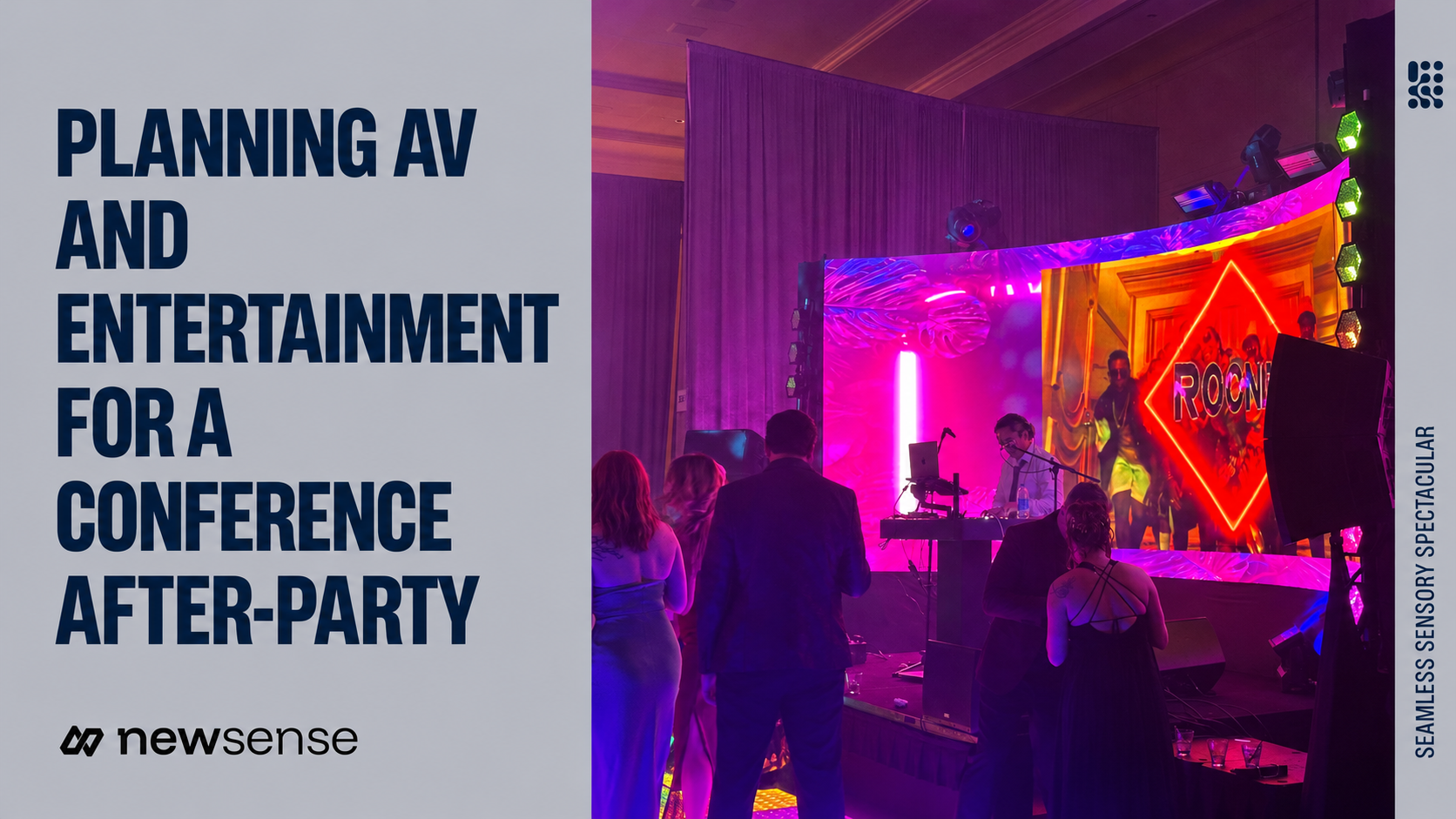
At StackFest 2025 in Orlando, StackAdapt brought together more than 1,200 employees. New Sense's closing-night production combined a neon-themed FOCUS3D LED DJ-and-drummer performance with full AV, custom lighting and technical and crew coordination. It was a defined evening scope within a larger company gathering.
That distinction matters when you book entertainment. Specify who supplies the performance systems, supports announcements and operates the screens and lighting. Identify what carries over from the conference and what must be added. Do not assume a performer booking includes production for the surrounding reception.
Also confirm how the audience should use the room. A celebration can have a performance focal point while preserving places to talk, sit and move comfortably. Those choices should reach the technical team before the layout is approved.
Design the handoff from conference to evening
Walk through the guest journey from the final session to the party entrance. Account for hotel-room breaks, transportation, registration and food service. For an off-site Orlando venue, confirm the arrival window with the transport coordinator and venue manager before setting the opening cue.
If the same ballroom hosts both events, ask what actually changes. Seating may move, a stage may be reconfigured and technicians may need to reposition equipment. Agree on a reset schedule that gives each team access without sending guests into work in progress.
Reusing equipment can be practical when its location, technical suitability and operating schedule fit both events. Have the production lead verify that plan before budgeting on the assumption that the daytime system covers the party. Include the crew time needed to reset, test, operate and remove it.
Bring performers into the technical plan
Request each act's technical rider, which describes its equipment and production needs, before finalizing the AV scope. The production lead should reconcile stage space, microphones, instrument inputs, monitor requirements, DJ connections and sound-check access with the venue.
Confirm which equipment the act brings and which the production team supplies. Assign responsibility for sound during performance, microphone handoffs and playback between sets. If performers and venue technicians are different teams, both need the same plan.
Brief performers on music preferences, clean versions where required, pronunciation and approved acknowledgments. Give the brand team a separate content sign-off. For StackFest, New Sense shared imagery and video from its existing library for StackAdapt to review against its standards and neon theme. Approved material was then organized for the show. Confirm what you are reviewing, who approves it and when it must be ready for playback.
Use one evening run of show
Create a shared sequence covering doors, background music, welcome remarks, entertainment sets, breaks and closing announcements. Name the person who calls transitions and the corporate contact who can approve a change.
For example, a networking reception could open with conversation-level music, pause for a short welcome, then move into a livelier set after food service. That is a planning example, not a fixed formula. Decide how lighting and screens change with each phase, and rehearse any moment that combines speech, playback and performance.
If the conference runs late, the team needs to know what can move, what can shorten and what must finish on time. Confirm performer extensions, crew overtime and venue closing conditions before the event, so a delay does not become an improvised spending decision.
Check the room under evening conditions
Ask the venue about permitted sound levels, neighboring events, lighting controls and restrictions on effects. For an outdoor reception, agree on weather decisions and a viable indoor alternative with the venue and production lead.
Check the guest-facing details too: can people find the entrance, see any announcements and move between performance and conversation areas? Include accessible routes in the final layout. New Sense's creative entertainment services can be considered alongside the corporate production brief, with the entertainment and technical scope confirmed together.
Frequently Asked Questions
Can the conference AV team support the after-party?
Possibly. Confirm equipment suitability, staffing, working hours and any location change. Treat evening coverage as an explicit part of the proposal.
Do we need an MC as well as a DJ?
Only if the program needs that role. Ask whether the booked DJ will make the required announcements or whether a separate host is appropriate.
What should we send when requesting a proposal?
Share the audience and purpose, conference finish time, evening venue, guest count, preferred entertainment, formal moments and end time. Include performer riders when available.