.png)
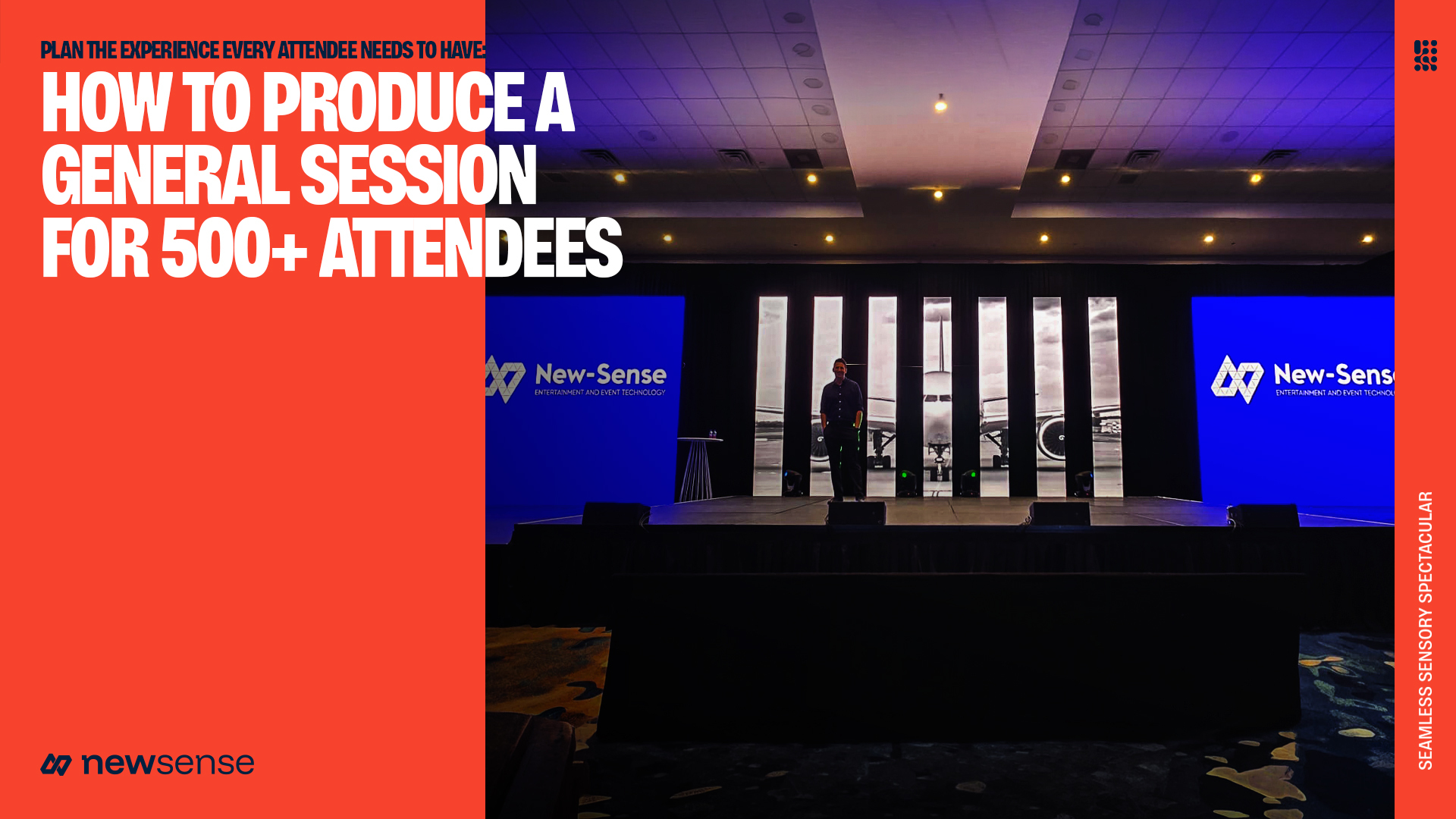
Five Hundred Attendees Change the Production Equation
The audience is farther from the stage. More people depend on the sound system. Screens must work across a wider range of sightlines. Speaker transitions become more visible, and small delays feel much longer when an entire ballroom is waiting.
Producing a large-scale general session is not simply a matter of adding more equipment. It requires a production plan built around the room, the program and the experience every attendee needs to have. Explore more about evolving strategies in our article on current trends in general sessions.
Start With the Program, Not the Equipment List
Before determining screens, microphones or lighting, the production team needs to understand what will happen onstage.
A general session may include executive presentations, panels, videos, awards, product announcements, entertainment and audience participation. Each element creates different requirements for staging, audio, content, cameras and show calling.
The first questions should include:
- What does the company need the audience to understand?
- Which moments carry the most business or brand importance?
- How many speakers and transitions are involved?
- Will presentations, panels or entertainment require stage resets?
- Will the session be recorded or streamed?
Once the program is clear, the production system can be designed to support it through comprehensive corporate event production solutions.
Advance the Venue Early
Two general sessions with 500 attendees can require completely different production plans.
Room dimensions, ceiling height, seating configuration, rigging options, acoustics, ambient light, power, load-in access and venue requirements all influence the design.
A technical venue advance allows the production team to identify those conditions early. It also helps align the venue, corporate team and production partner before decisions become expensive or difficult to change.
For Orlando and destination events, this coordination is especially important when the company planning the meeting is unfamiliar with the property or local production environment.
Design Audio for Every Seat
At 500+ attendees, clear audio cannot be assumed simply because the room has speakers.
The system must be designed around the room’s dimensions, acoustics, seating and program. A keynote, panel discussion, video playback and live performance may each require a different audio approach.
The production team should plan microphone requirements, speaker coverage, playback sources, monitoring and backups using integrated audio and video services. The objective is simple: every attendee should hear the message clearly without thinking about the technology delivering it.
Plan Screens Around Sightlines
A screen may look impressive from the production desk and still be difficult to see from the side or back of the room.
Screen size, placement and content formatting should be evaluated from multiple audience positions. Larger rooms may also require cameras and image magnification, or IMAG, so attendees can see speakers’ expressions and presentation details.
Content must be designed for the actual viewing distance. Slides created for a boardroom do not automatically work in a large ballroom.
Build a Stage That Supports the Program
The stage needs to accommodate speakers, panels, entertainment, scenic elements and safe transitions without feeling overcrowded.
Its height, width, access points and furniture should be planned around what will happen throughout the session, not only around the opening keynote.
Intelligent lighting and visuals should support both the in-room audience and the cameras. Branded visuals and scenic elements should give the session a clear identity while keeping attention on the message.
Create One Detailed Run of Show
Show calling connects the program with every technical and backstage action required to deliver it.
The run of show should account for:
- Speaker entrances and exits
- Microphone changes
- Presentation and video playback
- Lighting and music cues
- Camera direction
- Stage resets
- Awards and creative entertainment
- Timing adjustments
One show caller should coordinate these elements so speakers, content and technical teams follow the same plan.
Rehearse the High-Risk Moments
A complete rehearsal may not always be possible, but the most visible and complex moments should be tested.
Executive entrances, video playback, product reveals, panels, awards, entertainment and major transitions deserve dedicated rehearsal time. Content should be checked on the actual screens, and speakers should understand where to stand, enter and exit.
Rehearsal is where the team discovers problems while there is still time to solve them.
Prepare for Failure Without Showing It
Large general sessions require backup planning.
Critical presentations and videos should be available from more than one source. Essential microphones and playback paths need alternatives. The production team should know what happens if a speaker is late, content changes or the program falls behind.
The audience may never know those contingency plans exist. That is the point.
Experience at Scale Is Built Behind the Scenes
New Sense Productions has supported major corporate general sessions and complex, high-capacity live environments.
The company’s work includes a Walmart general-session experience and multi-area production featured in our AAU Junior National Volleyball Championships case study at the Orange County Convention Center. For AAU, an initial entertainment, LED and audio scope grew into production support across multiple competition areas. Learn more about our other large-scale events in the case studies library.
These events are different, but the production principle is the same: scale requires coordinated people, systems, content and decisions—not simply more gear, delivered through fully produced shows.
Planning a general session for 500 or more attendees?
Request a production consultation with New Sense Productions today.
Frequently Asked Questions
What AV does a 500-person general session need?
Requirements depend on the room and program, but may include distributed audio, wireless microphones, large-format screens or LED, cameras, IMAG, presentation management, show lighting and technical direction.
Does a 500-person general session require show calling?
Show calling is strongly recommended when the program includes multiple speakers, videos, panels, entertainment, awards or complex transitions.
How early should production planning begin?
Planning should begin as early as possible, particularly when venue coordination, custom staging, executive rehearsals, entertainment or original content is required.