
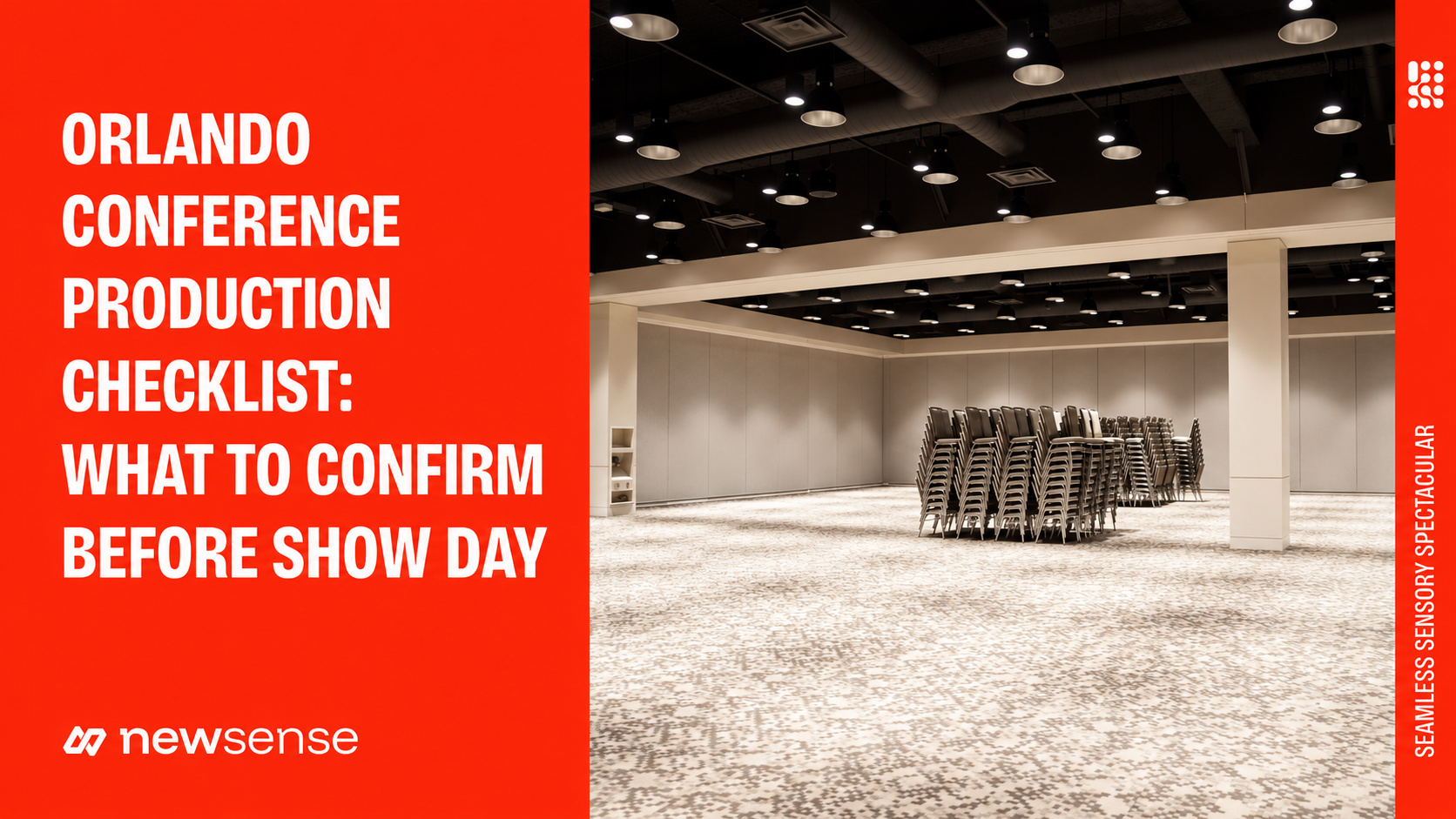
A conference production checklist should do more than confirm that screens, microphones, and lighting have been ordered. It should help your company protect its message, anticipate venue constraints, assign responsibility, and create an experience that feels consistent from the opening session through the final cue.
Orlando offers an exceptional range of convention centers, hotels, and resorts. That variety also means production conditions can change considerably from one property to another. Bringing your production partner into the process early allows the venue, technical team, corporate stakeholders, and planners to make informed decisions before the schedule and budget become difficult to change.
Use this checklist to identify the questions that matter before your next corporate conference in Orlando.
1. What Business Outcome Should the Conference Support?
Before discussing equipment, define what the conference needs to accomplish.
- What should attendees understand, feel, or do afterward?
- Is the company launching, educating, recognizing, selling, or aligning?
- Which sessions carry the greatest business importance?
- How should the brand be experienced in the room?
- How will leadership evaluate success?
These answers shape every production decision. A sales conference built around a new market strategy needs a different environment from an employee recognition program, even when both use the same ballroom.
Document the objective in one or two sentences and share it with the venue, agency, content team, and production partner.
2. Has the Venue Been Reviewed From a Production Perspective?
A ballroom may fit the anticipated attendance and still create challenges for staging, audio coverage, projection, or load-in.
Before approving the room plan, confirm:
- Ceiling height and usable rigging points
- Stage location and maximum dimensions
- Screen visibility from the rear and sides
- Columns, chandeliers, airwalls, and other obstructions
- Available backstage and equipment-storage space
- Loading dock access and freight-elevator dimensions
- Setup, rehearsal, room-turn, and strike windows
- Rules for external production partners
- Required venue services, labor, or supervision
At the Orange County Convention Center, for example, rigging, utilities, internet, shipping, and AV are managed as distinct services. Hotels and resorts may structure these responsibilities differently. Obtain the applicable policies and pricing directly from your venue rather than assuming the terms will match another Orlando property.
For a broader venue discussion, read What to Know Before Producing a Large Event in Orlando.
3. Does the Technical Design Match the Room and Audience?
The production system should be designed around the actual space, audience size, and content—not copied from a standard equipment package.
Audio
Confirm microphone formats, speaker coverage, press feeds, playback requirements, and accessibility needs. Large or divided ballrooms may require distributed audio so attendees receive consistent coverage throughout the room.
Video
Determine the screen size, aspect ratio, resolution, content sources, confidence monitors, recording needs, and whether delayed screens are necessary. Test important graphics from the farthest audience seats.
Lighting
Plan separately for presenters, scenic elements, audience moments, video capture, and room atmosphere. The lighting should help direct attention and support the brand without compromising camera exposure.
Connectivity
Dedicated internet may be required for streaming, remote speakers, demonstrations, or mission-critical show systems. Confirm bandwidth, wired connections, network support, and backup options with the venue.
Explore New Sense’s audio and video production capabilities.
4. Is the Content Designed for the Live Environment?
Conference content often arrives in formats created for laptops rather than large screens.
Create standards for:
- Presentation aspect ratio and file format
- Font size and visual legibility
- Embedded audio and video
- Speaker walk-on and walk-off cues
- Playback and presentation ownership
- File submission deadlines
- Last-minute revision procedures
- Lower thirds, holding slides, and sponsor recognition
- Brand consistency across departments and sessions
Identify who can approve content changes onsite. Without a clear decision-maker, a small revision can delay rehearsals or introduce the wrong version into the show.
5. Are the Schedule and Rehearsals Realistic?
A run of show should document more than session start times. It should include every technical cue, speaker movement, media playback, room transition, and responsibility.
Reserve enough time for:
- System testing
- Content review
- Executive rehearsals
- Presenter microphone checks
- Camera and lighting adjustments
- Show calling and cue-to-cue rehearsal
- Corrections before doors open
Rehearsals are especially important when executives, awards, demonstrations, entertainment, or remote participants are involved. They give speakers confidence and allow the production team to solve problems before the audience enters.
6. Are Responsibilities Clear Across Every Partner?
Orlando conferences may involve an internal event team, hotel staff, a DMC, creative agencies, an entertainment producer, and several technical vendors.
Create one responsibility matrix that identifies who owns:
- Venue communication
- Creative direction
- Technical design
- Content collection
- Speaker management
- Show calling
- Entertainment
- Registration and attendee flow
- Budget approval
- Final onsite decisions
The audience experiences one conference, regardless of how many companies helped produce it. Your partners therefore need one coordinated production plan.
7. Does the Budget Include the Complete Production Scope?
Review more than the core equipment estimate. Confirm whether the budget includes:
- Equipment and technical labor
- Venue-mandated services
- Rigging, electrical power, and internet
- Freight, drayage, and material handling
- Travel, lodging, parking, and per diem
- Rehearsal and overtime hours
- Content creation and playback support
- Recording, editing, or streaming
- Backup equipment
- Taxes and service charges
Comparing proposals only by their initial total can conceal important differences in scope. A reliable production partner should explain what is included, what remains variable, and which assumptions could affect the final investment.
8. What Is the Backup Plan?
Document how the team will respond if a presentation fails, a microphone stops working, a speaker arrives late, the internet becomes unstable, or the agenda changes.
Redundancy should reflect business risk. A leadership announcement or product launch may justify backup playback, additional microphones, redundant signal paths, and recorded assets that would be unnecessary for a small breakout.
Orlando Conference Production Checklist: Final Review
Before approving production, confirm that:
- The business objective is documented.
- The venue has been technically reviewed.
- Venue-mandated services and fees are understood.
- Audio, video, lighting, power, and internet are confirmed.
- Content specifications and deadlines have been distributed.
- The run of show includes technical cues and owners.
- Rehearsal time is protected.
- Every partner’s responsibility is documented.
- The budget reflects the complete scope.
- Backup plans exist for critical moments.
- Final decision authority is clear.
Frequently Asked Questions
When should a production company become involved?
Ideally, before the venue contract and room layout are finalized. Early involvement allows the production team to evaluate access, rigging, sightlines, power, acoustics, and scheduling while meaningful changes are still possible.
Can an external production company work in an Orlando hotel or convention center?
Often, yes, but the venue may require certain in-house services, approved labor, supervision, insurance, or fees. Request the venue’s current production policies in writing.
What information does a conference production company need for an initial estimate?
Provide the venue, dates, attendance, room schedule, program format, stage concept, content needs, rehearsal requirements, recording or streaming scope, and any existing venue proposal.
Is a technical rehearsal necessary?
Yes, particularly for general sessions involving executives, multiple presenters, videos, awards, entertainment, or complex transitions. A rehearsal protects both the speakers and the audience experience.
How do we choose the right production partner?
Look beyond equipment pricing. Evaluate how the company approaches business objectives, creative direction, technical planning, venue coordination, show execution, risk, and communication.