
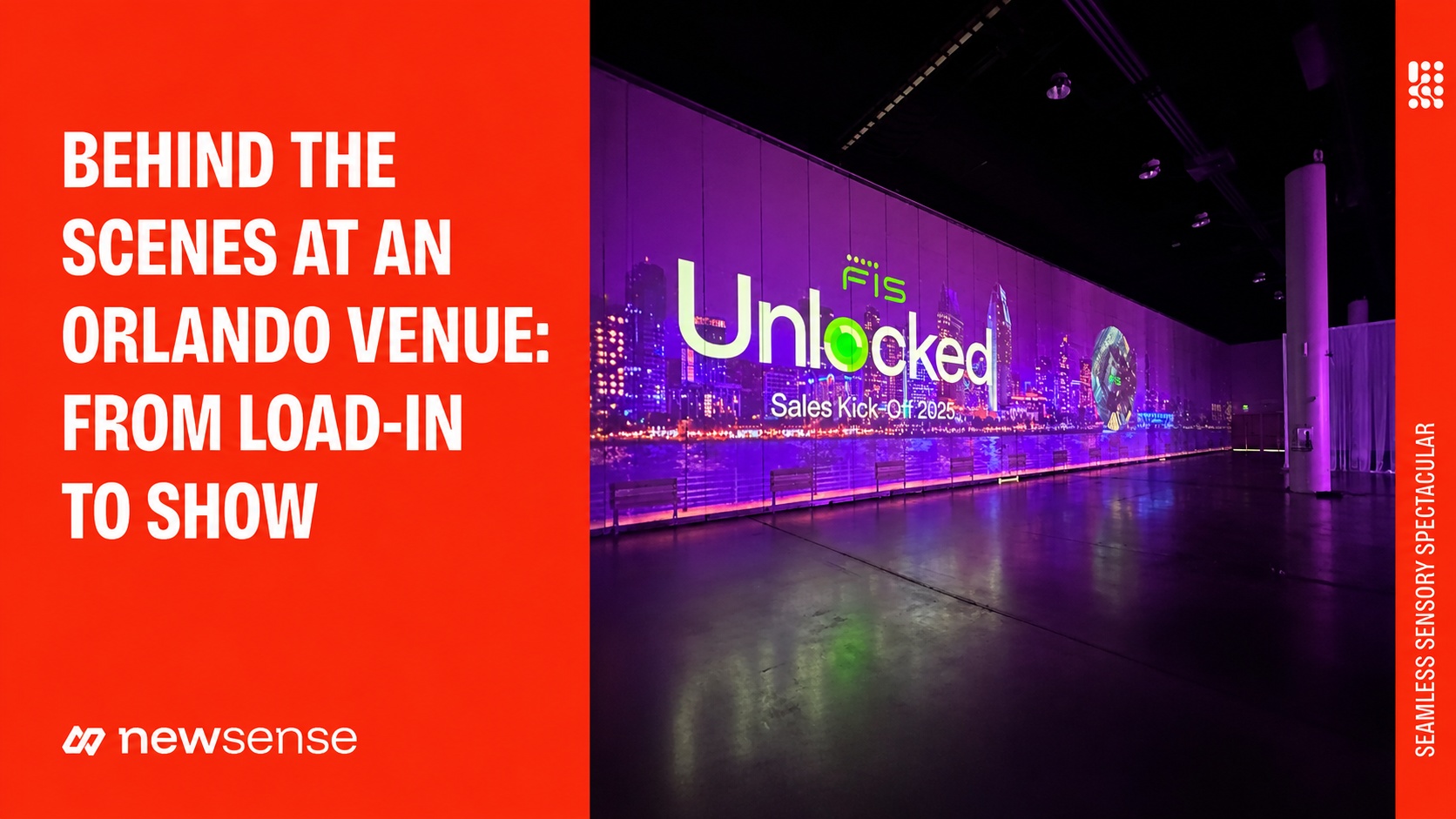
When an event transforms a familiar Orlando venue, the audience sees the finished environment. They do not see the equipment arriving, the systems being installed, the content being tested, or the teams coordinating behind the scenes.
That hidden work is where much of the event’s value is protected. A successful load-in gives creative ideas enough time and technical structure to become a reliable live experience. It also helps the company protect its message, guest experience, schedule, and reputation.
FIS Emerald 2025 offers a clear example. For one of the conference’s signature evenings, New Sense Productions helped transform part of the Walt Disney World Dolphin Resort into Viva! La Música, a Latin festival-inspired experience culminating in a live performance by Pitbull.
Here is what happens between an approved concept and the first show cue.
What Must Happen Before Load-In Begins?
A successful load-in starts well before a truck reaches the venue.
FIS Emerald 2025 brought clients, prospects, and partners together in Orlando for four days of programming. The May 21 evening experience needed to feel connected to the larger conference while creating a distinct shift in energy.
New Sense was initially engaged to provide custom video mapping. As planning progressed, the assignment expanded into a more integrated visual production involving projection, lighting, venue architecture, rigging, power, and custom 3D content.
That expansion required more than adding equipment. Each discipline had to support the same creative direction and work within the physical conditions of the resort.
Before arriving onsite, an event production team may need to resolve:
- Creative and brand requirements
- Venue measurements and projection surfaces
- Equipment placement
- Rigging and electrical requirements
- Content dimensions and playback formats
- Sightlines and guest movement
- Access, labor, and installation schedules
- Responsibilities across production and venue teams
The goal is to settle as many decisions as possible before onsite time becomes the most limited resource.
Why Did the Production Require a Five-Day Load-In?
The FIS Emerald production included five days onsite. That timeframe reflects the coordination involved in building a mapped environment around real architecture.
Projection mapping depends on precise alignment between digital content and physical surfaces. Projectors must be positioned, calibrated, and tested. Lighting must complement the mapped imagery without washing it out. Rigging and power must support the complete system safely and reliably.
The visual content also needs to be reviewed in the actual space. A sequence that looks right on a monitor may feel different when projected across architectural features and viewed from the guest area.
A longer load-in provides time to address those realities before the venue fills with attendees. It also allows the production team to coordinate around other conference activities taking place at the property.
For corporate leaders, this preparation is an investment in reliability. For planners, it creates the working time needed to solve problems before they become show-day problems.
How Does an Orlando Venue Become Part of the Show?
The venue was not simply a container for Viva! La Música. Its architecture became the canvas.
Custom content was developed to respond to the proportions and surfaces of the space. Projection, lighting, and architecture shared one visual language, allowing the environment to feel cohesive rather than assembled from separate production elements.
That distinction matters. A branded graphic placed on a screen can identify the company. A visual experience designed around the room can make the brand feel present throughout the space.
This approach is particularly relevant in Orlando, where corporate conferences often take place inside large resorts and destination properties. These venues offer scale and visual character, but they also introduce specific requirements involving access, rigging, power, ambient light, and coordination with venue teams.
Companies considering this type of transformation should involve production before the room plan and technical scope are finalized. Read What to Know Before Producing a Large Event in Orlando for additional venue considerations.
What Happens During Technical Integration?
Technical integration is the process of making every production system behave like part of one show.
For Viva! La Música, that meant coordinating:
- Custom 3D visual content
- Projection mapping
- Venue lighting
- Rigging and power
- Technical programming
- Music and live entertainment cues
Each element affected the others. Projector placement influenced rigging. Ambient and production lighting affected image visibility. Content dimensions had to match the architecture. The visual sequence needed to support the energy of the evening and the live performance.
This is why complex events benefit from clear production ownership. When teams work from one creative and technical plan, decisions can be evaluated based on the whole audience experience.
What Is Tested Before the Audience Arrives?
Testing is not limited to confirming that the equipment turns on. The production team must determine whether the experience works from the guest’s perspective.
That includes reviewing:
- Projection alignment and focus
- Color and brightness across mapped surfaces
- Lighting levels and programmed cues
- Media playback and signal paths
- Sightlines from different viewing positions
- Timing between visual and performance moments
- Backup plans for critical systems
- Communication between operators and show leadership
Adjustments made during this stage may be small, but their impact is visible. A delayed cue, an image that falls outside its surface, or competing lighting can break the illusion the creative team worked to build.
What Did the Finished Experience Accomplish?
On May 21, the conference environment shifted into Viva! La Música. The evening combined the visual language of a Latin music festival with a performance by Pitbull, giving attendees an experience that felt distinct from the daytime conference program.
The transformation was also recognized from the stage. Looking at the visuals, Pitbull remarked that they made him feel at home.
That reaction captures the value of site-specific production. The technology supported a meaningful sense of place, energy, and connection rather than becoming the focus itself.
See the complete FIS Emerald 2025: Momentum case study.
Frequently Asked Questions
How long does an Orlando event load-in take?
Timing depends on the venue, production scope, room access, rigging, content, and rehearsal requirements. A straightforward AV setup may require considerably less time than an architectural projection or integrated show environment.
Why should production be involved before the event reaches the venue?
Early involvement allows the team to review venue conditions, determine technical feasibility, coordinate responsibilities, and identify costs or schedule limitations before they affect execution.
Can New Sense work with a DMC or another production provider?
Yes. For FIS Emerald, New Sense worked alongside Hello Florida and another trusted production partner. The company can lead the complete production or provide specialized creative and technical capabilities within a larger team.
What information is needed to plan projection mapping at a venue?
The production team typically needs venue measurements, photographs or scans, projection surfaces, ambient-light conditions, guest sightlines, access times, rigging information, power availability, and the creative objective.